

It has been 25 years since the horrific terrorist attacks of 9/11 that took the lives of nearly 3,000 individuals — not all Americans, not all on the planes used as bombs or in the collapsed offices in the Twin Towers in New York City, not all adults, not all found and identified. For some of us, including me, the event haunts.* It is a day that cannot be forgotten, just as the murders of John F. Kennedy, The Reverend Martin Luther King Jr., and Robert F. Kennedy, and all the wars and deaths that have followed cannot be forgotten. The bells still toll. Names of the dead and missing are still read aloud.
In the years since, an official report from the National Commission on Terrorist Attacks Upon the United States, has been issued; albums of extraordinary and heart-breaking photographs have been compiled; films have been run over and over; plays, political and not, have been performed; cultural studies of personal, cultural, clinical, and scholarly essays have been published; emails exchanged with loved ones on 9/11 have been shared publicly; nonfiction histories have filled bookstore shelves; oral histories and first-person accounts, including essays by family members, survivors, and on-scene witnesses, have been recorded or gathered, some made into podcasts; novels, including romances, have been written; even children’s picture books have been made.
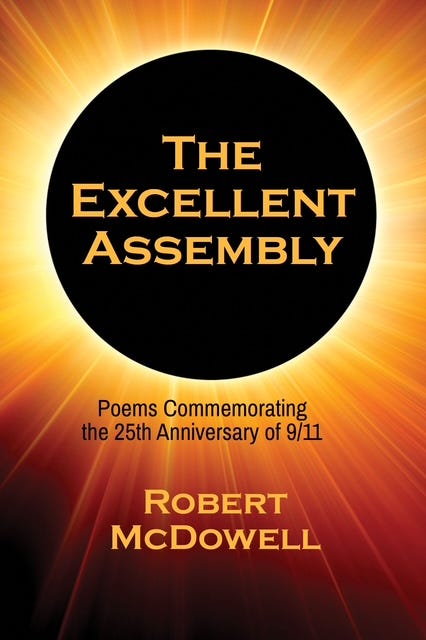
Poetry about 9/11 is not wanting. Many voices have been raised to honor and memorialize those who died, with most of the contributions collected in anthologies, although some have come from prominent individuals, such as poets Galway Kinnell, Steven Berkoff, and Robert McDowell, the subject of my interview. What McDowell has done in The Excellent Assembly, uniquely among the rest, is to bring together fictive lyrical narrative poems and monologues (persona poems) to remember the dead, those who survived, and the men and women whose heroism still inspires.
~ Maureen Doallas, Writing Without Paper
Interview with Poet and Writer Robert McDowell
Writing Without Paper: Let’s begin by setting some context. What do you recall of your experience of 9/11?
Robert McDowell: I was stunned, shocked, terribly sad — like everyone. If words were spoken, they were few and quiet. When I needed a break from watching events unfold on television, I took a walk along a country route I normally ran but that on that day felt too leaden to try running. I walked, and gradually I noticed something “off,” not normal. I thought it must be more emotional fall-out but this was physical, outside myself. I must have walked another mile or so before I looked up at the brilliantly blue sky and realized what was wrong. There was no sound, not one plane near or far announcing its coming or going. That was shocking. I couldn’t remember a time when there wasn’t aircraft noise. It felt eerie. As I walked on, I thought of my friends in New York and wondered who among them might have died. I thought about what had died in all of us, and what, if anything, might have been born.
WWP: Did what you remember of that day subsequently have any bearing on the form or content of the poems you wrote and included in your new collection?
RMcD: All of it had to do with the form and content of the poems to come. I didn’t think about writing a poem or poems that morning or later that day or even shortly after. Soon, we were flooded with 9/11 poems of all kinds, and that made me feel like going slow. Writing a poem helps one process, yes, but I felt a need to process, process, and then process some more before even attempting to write poetry about what happened on that day.
WWP: How soon after 9/11 did you begin thinking about writing a collection about this momentous event?
RM: It was almost a year later. That is clear in my mind because I was teaching a workshop at the Taos (New Mexico) Writers Conference. I was in my motel room working on two poems about 9/11. My partner asked me about them. I read them to her with more than a little reluctance, yet she liked them and encouraged me to do a whole book. That was the first time I considered the idea. Even then, I wanted to take my time. Intuition voiced her caution, and I heard again a sentence whose wisdom I cherish. It’s a sentiment by the great late Bodhisattva and UCLA basketball coach John Wooden — “Be quick but don’t hurry.”
WWP: Did you always have the 25th Anniversary in mind as the collection’s publication date?
RMcD: No. I thought I’d bring out a book like this much sooner, but no time ever seemed like the right time. Intuition, again. I thought a book would appear on a significant anniversary; one by one, the anniversaries passed: the 10th, the 15th, the 20th. Then it seemed to me that the 25th anniversary was perfect. It felt right. And, if I’m honest, I had begun to feel that I might not be around for the 30th anniversary.
WWP: The Excellent Assembly comprises persona poems. Why persona poems?
RMcD: Why not? I began writing persona poems when I lived in the Mojave Desert. Enchanted by the spells and characters I met there, I wanted to tell those stories in poems. Sometimes I worked in third-person narratives but I also enjoyed experimenting by assuming the identity of someone else. It was liberating. Dangerous, sometimes, but liberating. A good persona poem conveys an immediacy that is compelling.
WWP: What, if any, pushback, even from yourself, did you experience in deciding to write poems in voices representative of the people on the ground, in the offices, and on the planes?
RMcD: I meditated a lot. I asked myself if it was appropriate to even attempt such a collection. One ghost from my past told me I had no right to do such a thing, that I could not speak for the victims and survivors. I took that admonition seriously. I sought the opinion of others. A few thought I would be out of line to write and publish the poems, although others encouraged me to do so. Obviously, I came down on their side but not without some clear understanding. It was essential that the speakers in my poems be invented characters. I don’t mean for them to be actual passengers on any of the planes. In an earlier draft, I’d assigned each poem to a seat number on one of the planes. I saw the error in that. A seat number would correspond to a real person, a passenger. I scrapped that element and gave the poems titles. The only real-life character is the president [George W. Bush, “43”], who is readily recognizable in one poem. Yet, even the situation in that poem is invented. The rest are fictions, though I hope they embody empathy, poignancy, and truth.
WWP: Did you “workshop” any of the poems among other poets or people whose opinions you admire?
RMcD: Yes; some, though not all. Over a long period of time, I tried out several of the poems on three readers I count on. As always, they gave helpful suggestions and, in a couple of cases, they rightly encouraged me to scrap a poem.
WWP: What factored into your choice of voices?
RMcD: This is a good question!
So much is intuition, the voices of Divine Guardians in my head. I imagined a character, someone with a life beyond the drama of the day, someone with a job, a partner, a plan, a dream, a lost love. Then I asked them to speak, to tell me — the reader — their story. Some were angry or disdainful. Some were bewildered. Others were empathetic, even philosophical, and some were terrified and desperate. There were other voices, too.
I’d love to know what readers think [of these voices].
WWP: In your opinion, which of the voices have you been most effective in capturing?
RMcD: I don’t know that I can say. I like to think that every poem I decided to include in the book works. The voices work, all of them. Every day, I have favorites, of course, but that changes. Today, it’s the three poems in the voices of baggage compartment pets. Yes, I do enjoy writing in the persona of an animal, or a tree, or a flower.
Baggage Compartment, Dog Talk [Excerpt]

When are we going to say we've had enough
Of being treated like afterthoughts? Let's tell
Them, Hey! We'd like some changes in our meals
Instead of the same thing over and over.
Do you ever watch their eyes when they feed us?
They're only present when they want our help.
They're grateful we lower their blood pressure,
But mostly they're unfocused.
                                                                  You're a bad
Dog, Carl, for saying such things. They take us in.
They keep us safe. They walk us, play with us
And take us to the vet. They even bring
Us on their trips—like this.
                                                                   Oh, Shep,
It's sad—the tripe you swallow, the news you miss.
How many tranquilizers did you eat
Before they kenneled you?

[. . . .]
WWP: What factored into the number of poems you wrote, as well as the organization of the poems?
RMcD: The overall book organization came to me early. It was fast. I wanted a fairly equal representation of poems for each of the four flights. In fact, that was an earlier title of the book: Four Flights. Two flights have 13 poems, one has 11, the other, 10. There are four poems in the voices of people on the ground, including one who is expecting the imminent arrival of a loved one and another in the voice of a man who missed one of the flights. (Two of my friends were so lucky.)
WWP: You mention that earlier title for the collection. How did you come to finally title it The Excellent Assembly?
RMcD: I include information in the front matter, before the Foreword, to explain this. I wrote, “The Excellent Assembly, as described in the Purana, signifies a remarkable gathering of wise and virtuous individuals united for discussion or a common goal. It is metaphorically illuminated by the sun, symbolizing enlightenment.”
Readers will discover at the end of the collection several prayers and mantras that I invite them to use in observing 9/11.
[For detailed information, see the link for Purana in the Notes following McDowell’s biography.]
WWP: If you had to select a “Top 5” from the collection, which poems would you select, and why?
RMcD: This is almost impossible, because, as I said earlier, I have preferences day-by-day. For the last couple of days, I have kept hearing “The Power of Intention” in my head. I like the subject, the line movements, and the poem’s tone of acceptance and reconciliation. I’ve mentioned before animal-voiced poems; I’ll put them here, too. The animals are guileless. They speak with the unadorned wisdom — of cats, of dogs. “Not Quite Grounded” is a sonnet, a form that appropriately contains and mirrors the speaker’s effort to manage internal fear. Perhaps the most triggering poem is “Brothers of Dust to Dust,” a short dialogue between two of the hijackers. That was a difficult poem to write, and it took me a long time; yet, I felt there had to be at least one poem representing the antagonists, who were also victims that terrible day.
Not Quite Grounded

I know if I just sleep they'll go away.
The person sitting next to me is sweating
On my arm. I want to say, excuse me, do
You mind? But would that get us anywhere?
He's terrified. Maybe we should pray.
I look around and see that some are doing
Just that. I should be joining them but go
Instead to the bathroom, or try, but there's
A hand all knotted in my hair. Today
I go along with it, surprised by this thing
That's growing in my gut, an icy floe.
I'm forced to the floor; the morning is so fair!
I see it through the window as we dive,
So urgent, earthward, marvelous, alive.
WWP: It’s estimated that 100 million Americans were born after 9/11 or were too young at the time of 9/11 to have any memory of it, understand its significance, or commemorate it meaningfully. How might your collection of voices-in-the-moment help connect these Americans to the event or serve as an aide memoir? Do you envision the book being used in high school or college classrooms? If yes, how?
RMcD: Isn’t that statistic staggering? It’s similar to a figure I read just the other day. According to a news story, 66 percent of Millennials [generation born 1981-1996] have no association with the word “Dachau.” How is that possible? What is happening to our collective memory? It is irresponsible and even dangerous to not know about or to forget the past.
I hope that The Excellent Assembly finds readers. I hope it provides comfort, commiseration, peace, and reconciliation.
I’d love to see the book used in high school and college classes. I think many students would be engaged by these poems.
WWP: Given its subject matter, does this collection require anything different in publicity, or marketing and placement, that would not be considered for any poetry collection generally?
RmcD: A great question! One I wish I had better answers to.
What sets this book apart, of course, is its single-mindedness, its connection to a specific historical event that did, in fact, change the world. I wish bookstores would recognize that.
I hope that the general reader discovers value in the poems and shares that satisfaction with others. I can imagine a book club or study group focusing on 9/11 reading and discussing this book. I’d love to hear suggestions and ideas from anyone.
The Power of Intention [Excerpt]

[. . .] Why don't we pass the word
To write on folding trays and seats in front
Of us, on windows and window shades, on wall
And ceiling panels, even on the floor.
Let's cover the plane with words like love and peace.
Let's write them on ourselves. Give me your arm.
___________________________
Robert, thank you for so generously giving thought and time to my interview questions.
Readers with questions of their own are invited to leave those questions in the Comment section following the Notes. I will be sure the poet receives them to answer.
The Excellent Assembly (paper), published by Homestead Lighthouse Press (HLP), is available to pre-order; its official publication date is September 11. The collection can be ordered from brick-and-mortar stores, as well as online bookstores, including Bookshop.org, or directly from the publisher at HLP.
Biographical Information
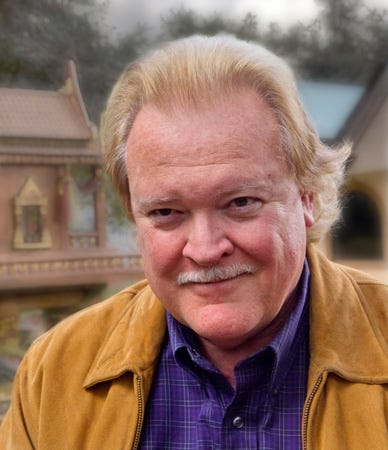
Robert McDowell is recognized as a leading proponent of New Narrative/New Formalist poetry. His poems, whether composed as formal or free verse, always brings together lyric and narrative (storytelling) elements, setting them apart from much of contemporary poetry. Numerous anthologies, poetry magazines, and such leading journals as The Hudson Review, Poetry, Best American Poetry, and The New Criterion have published his work.
In addition to poetry, collections of which include, most recently, Sweet Wolf: Selected & New Poems, McDowell has published fiction, nonfiction, and criticism. He has edited or co-edited a wide range of books, including Poetry After Modernism and, with Joseph Bednarik and Mark Jarman, One Man Boat: The Writing of George Hitchcock. He created and co-edited with Jarman the influential literary magazine The Reaper. His how-to writers’ guides on sonnets and haiku and overcoming writer’s block are available as e-books. Poetry as Spiritual Practice: Reading, Writing, and Using Poetry in Your Daily Rituals, Aspirations, and Intentions, first published in 2008 and reprinted in 2016, has been described by author Mirabai Starr as “brilliantly insightful.”
McDowell co-founded, with Mark Jarman and Lysa McDowell, Story Line Press, where for 22 years he served as director and editor, selecting and guiding into print more than 300 books.
Currently a professor at Ohio’s Kent State University, McDowell also has taught at the University of Southern Indiana, University of California Santa Cruz, and in Bennington College’s low-residency MFA program, which he co-designed with the late poet, essayist, and educator Liam Rector.
McDowell continues to write his long-time newsletter Read a Friend’s Heart on Substack and is the founder and publisher of Homestead Lighthouse Press.
Notes
*I lived within a few miles of the Pentagon, in Arlington, Va., and was working in Washington, D.C., on 9/11. I will never forget the blackness and thickness of the smoke that I could see rising, as it did for days after, as I drove across Key Bridge in the afternoon. (Traffic jams prevented my leaving the city at 10:00 a.m., when we were dismissed; I finally got out at 2:30 p.m., all bridges closed one way, streets going into the city blocked off, soldiers with enormous weapons at intersections. Once home, I found that cellphone service was impossible for a long time; it was frightening not to know where my son was.) Nor can I forget having to drive by the Pentagon a day or two later. Seeing it in pictures did not, still does not, convey the size of the enormous gash made by the plane as it went through the building to the central courtyard. It brought me to tears. My next-door neighbor, an Army chaplain, took round-the-clock duty at the Pentagon that day and for several days thereafter. Hearing his stories of what he confronted there was horrifying and profoundly emotional, grief-filled. Many days after 9/11, I learned of the tragic death of a college classmate who worked in one of the Twin Towers and of the death of a member of my parish. What also was unforgettable was the extraordinary blue color of the sky that morning, not a cloud to be seen, not a bird to be heard, and certainly no air traffic anywhere.~ Maureen Doallas
It should be noted that, officially, although 2,977 people died on September 11, 2001, the number of dead has continued to rise, because a decision was made to include in the New York City toll firefighters and others who acquired illnesses from working directly at the scene in the days and weeks thereafter. So, for example, on 9/11, the official count of FDNY firefighters who died was 343; 15 years later, more than 110 additional personnel have been reported. See “Statistics from 9/11 and 15 Years Later". Improvements in forensic science generally and DNA testing specifically have lead to additional identifications.
9/11 National Memorial and Museum
25th Anniversary at 9/11 Memorial and Museum and Anniversary Toolkit
National 9/11 Pentagon Memorial (This is a deeply moving memorial. A Visitor Education Center has been added since the opening of the Memorial, which is available 24 hours a day, 7 days a week.)
9/11-Related Print Anthologies and Collections of Poetry in the Library of Congress
Anthologies of 9/11-related poetry include Poetry After 9/11: An Anthology of New York Poets, An Eye for An Eye Makes the Whole World Blind: Poets on 9/11, September Morning: Ten Years of Poems and Readings from the 9/11 Ceremonies New York City, Crossing the Rift: North Carolina Poets on 9/11 & Its Aftermath, and Remember: Poems for the 20th Anniversary of 9/11. All of these can be ordered online.
Troy Closson and Maia Coleman, “Were You Born After 9/11?” in The New York Times, August 6, 2026 (At the time of this writing, an article with survey results had not appeared.)
Hannah Hartig and Carroll Doherty, “Two Decades Later, the Enduring Legacy of 9/11,” PEW Research Center, September 2, 2021
Conference on Jewish Material Claims Against Germany (Claims Conference), U.S. Millennial Holocaust Knowledge and Awareness Survey, 2020
New Narrative and New Formalism
Liam Rector (1949-2007)
Pre-publication Review of The Excellent Assembly by M. Sarki on Substack
I have a particular appreciation for fine titling and am always disappointed by a flat or uninspired title. The Excellent Assembly, for this body of work especially, is outstanding.
So moving and so appropriate and so needed as we approach the date. An insightful interview about both subject and process. Heartfelt thanks to you both.